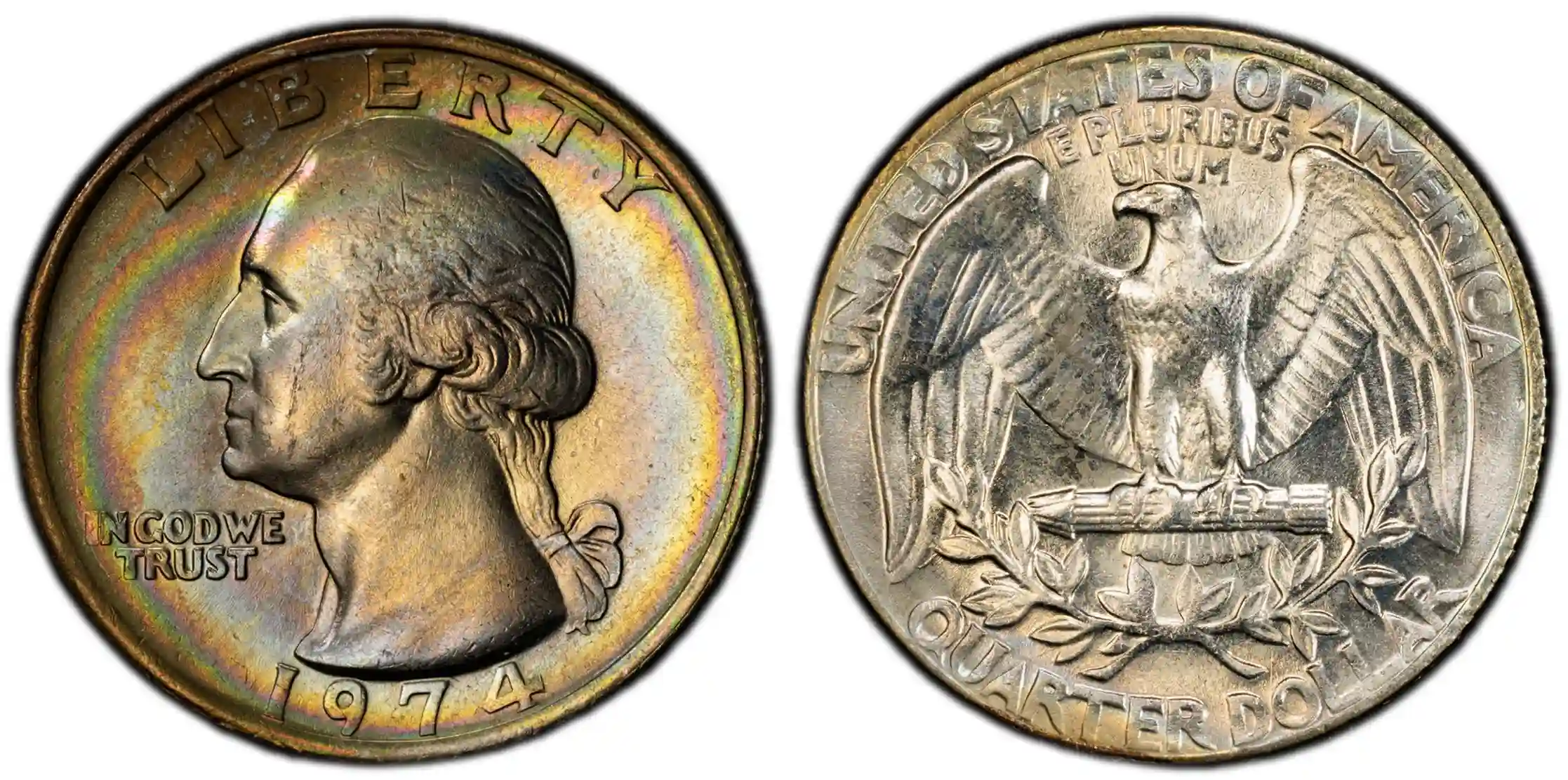
The 1974 quarter value is $0.25, but if you have high MS-67 or proof San Francisco issue you can have $100 investment for your great future collection.
1974 Quarter Overview & Production History
| Year | 1974 |
| Diameter | 24.30 mm |
| Weight | 5.67 g |
| Edge | Reeded |
| Composition | Copper-Nickel Clad |
In 1965, the United States Mint altered the course of American coinage. The government phased out ninety percent silver quarters due to the rising price of silver bullion. The mint introduced an alternative format: a copper-nickel clad composition.
- Outer Layers – seventy-five percent copper and twenty-five percent nickel
- Inner Core – copper
- Economic Purpose – these coins served purely as tools for daily transactions
- Public Response – citizens no longer hoarded quarters for metallic value
Circulated Quarters
Circulation destroys numismatic value for modern clad coins. Friction from coins that rub together in pockets leaves clear damage:
- Deep scratches across the metal fields.
- Heavy dents on the rim.
- Flat areas in Washington’s portrait.
If a 1974 quarter shows clear signs of use, it lacks collector appeal. It contains no silver, so metal buyers ignore it. Check other circulated examples on coin-identifier.com, that fetch exactly twenty-five cents at local stores.
Uncirculated Quarters Value Chart
The uncirculated item price is usually more than $0.25.
| Grade | Item Price |
| Circulated | $0.25 |
| MS-63 | $1.00 |
| MS-65 | $26.00 |
| MS-66 | $50.00 |
| MS-67 | $260.00 |
1974 Quarter Mint Marks
To find the origin of your Philadelphia coin, inspect the obverse side. Look at the small space to the right of Washington’s ponytail. If you find an empty field without a letter, the Philadelphia Mint produced the piece.
Denver Issues
If you locate a capital letter D next to the ponytail, your quarter came from the Denver Mint. High-grade issues carry steep bonuses because of severe die fatigue from a rapid manufacturing process:
The Denver facility rushed to meet high production quotas. Employees ran the steel coin dies long past their normal utility lifespan. Worn dies produced coins with mushy details and soft lettering. Worn dies also left orange-peel surface textures on the planchet.
San Francisco Issues
The mint did not release these coins into circulation. Workers struck these pieces on specially polished blanks with treated dies to create a mirror-like finish.
Standard Proof – a regular proof has shiny surfaces but lacks contrast between the fields and the design.
Cameo Proof – a cameo proof exhibits light frost on Washington’s portrait, which creates a modest visual contrast against the dark, reflective background fields.
Deep Cameo San Francisco Items
The top tier of proof coins features the Deep Cameo or DCAM designation from PCGS or Ultra Cameo from NGC. This effect requires a specific production state:
Fresh Dies is a technician who fresh-frosts a new die with acid or lasers. The first few hundred strikes receive a heavy coat of white frost on the raised designs. This frost creates a stark contrast against fields that resemble black ice.
The Quarter Mintage
Total mintage is 1,154,616,300 pieces.
| Mint | Mint Mark | Mintage |
| Philadelphia | No Mint Mark | 801,456,000 |
| Denver | D | 353,160,300 |
| San Francisco | S | 2,612,568 |
1974 Quarter Errors
1974 Clipped Planchet Quarter Errors
Mechanical errors can happen before the strike occurs. A machine punches circular metal discs from a long strip of metal to create planchets. If the strip fails to advance the proper distance, the punch overlaps a previous hole.
Off-Center Strikes and Misaligned Dies
If a planchet does not sit squarely inside the collar mechanism, the dies strike it off-center. This mistake leaves a portion of the coin blank, flat, and devoid of detail.
5 % to 10 % Off-Center Value $20.00–$45.00
20 % to 30 % Off-Center Value $75.00–$130.00
40 %+ Off-Center (With Full Date) Value $150.00–$300.00
Doubled Die Obverse
A doubled die receives two distinct impressions from a hub at slightly different angles. Collectors inspect the word LIBERTY and the motto under magnifiers to spot thickness and clear separation lines.
Filled Mint Mark Varieties
Heavy press use can cause a die break inside the small cavity of the D mint mark. The metal fills the letter, which leaves a solid blob instead of a clear letter center.
Critical Value Drivers
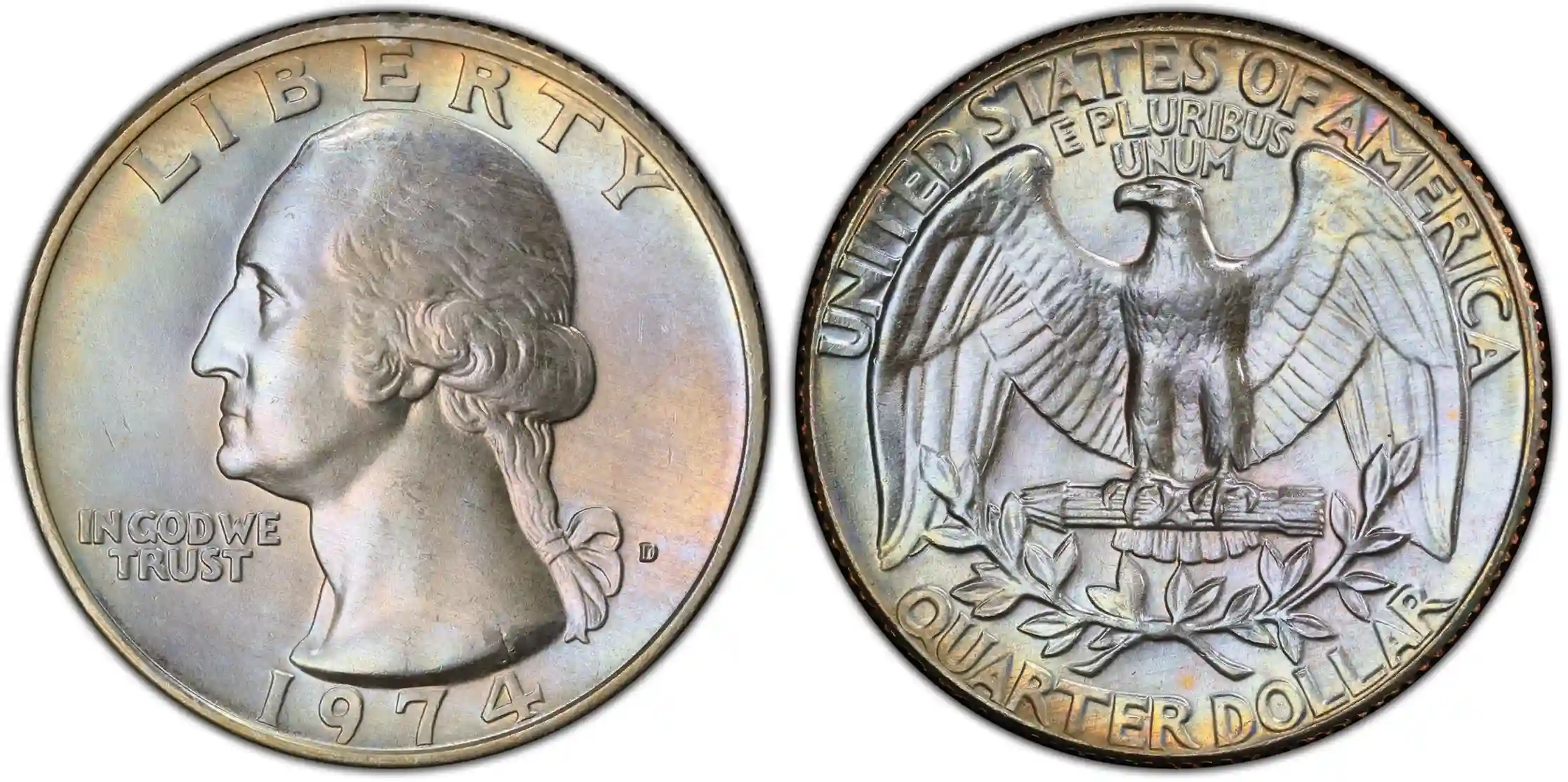
Surface quality dictates market price. When a coin leaves the die, it possesses specific traits that determine appeal:
Cartwheel Luster – a microscopic texture that reflects light in a rotating pattern.
Surface Cleanliness – an absence of dark tone, cloudy fingerprints, or chemical spots.
Contact Preservation – high protection from contact marks, which keeps Washington’s cheek smooth.
Analyzing the PCGS and NGC Population Census Reports
Numismatists track rarity through population reports from major grading firms. Thousands of 1974 quarters reside in the MS-65 and MS-66 categories.
Supply caps tightly at the MS67 tier. When the census shows only a few dozen coins at the top grade, intense bidding wars erupt among registry set collectors who want to own the finest collection in the world.
Where to Buy 1974 Washington Quarter
GreatCollections – a premier destination for certified modern coins. This platform features a high volume of weekly auctions where you can track down PCGS- and NGC-certified MS-66 or MS-67 1974 and D quarters without overpaying.
Heritage Auctions – ideal for record-breaking condition rarities. If an elite MS-67+ regular strike or a flawless PR-70 Deep Cameo proof hits the market, it frequently runs through a Heritage signature auction.
Stack’s Bowers Galleries – known for historic coin collections and highly accurate professional cataloging. It is a reliable marketplace for high-grade clad single entries and rare structural errors.
eBay – the absolute largest supply of OBW Rolls and original 1974 U.S. Mint uncirculated year sets. It is also highly efficient for sourcing affordable, standalone S proof coins in standard plastic flips or third-party holders.